Terracotta Warriors: The Complete Guide
Everything you need to know before visiting the 8th Wonder of the World — tickets, timing, transport, and how to have the best experience.
Written by Li Wei
History & Culture Writer · Xi'an since 2019
Li Wei has lived in Xi'an since 2019 and has visited every major museum and historical site in Shaanxi province at least three times. He spends his weekends exploring forgotten Tang dynasty ruins and reading Ming-era city maps. Before writing travel guides, he worked as a research assistant at the Shaanxi History Museum.
Opening Hours
8:30 AM – 6:30 PM
Mar 16 – Nov 15 (peak)
Off-Peak Hours
8:30 AM – 6:00 PM
Nov 16 – Mar 15
Ticket Price
$18
Students $4 seniors $4
Visit Duration
3-4 hours
All three pits + exhibition hall
Best Time
8:30 AM sharp
Empty halls before 10 AM
Location
Lintong District
40 min east of downtown
What Are the Terracotta Warriors?
The Terracotta Warriors are a collection of more than 8,000 life-sized clay soldiers, horses, and chariots buried with Qin Shi Huang, China’s first emperor, around 210-209 BC. They were discovered in 1974 by local farmers digging a well, and the site is now a UNESCO World Heritage Site and one of the most significant archaeological finds of the 20th century.
Each soldier has unique facial features — no two faces are identical. They were originally painted in bright colors (red, green, purple, blue) that faded within minutes of exposure to air after excavation. The site covers approximately 20,000 square meters across three main pits, and only about 2,000 warriors have been fully excavated so far. An estimated 6,000 more remain underground.
The warriors are part of a much larger necropolis complex that includes the emperor’s actual tomb (still unopened), located 1.5 km away under a 76-meter hill. Ancient texts describe the tomb as containing rivers of mercury and a map of the heavens on the ceiling. Soil tests have confirmed elevated mercury levels, suggesting the texts may be accurate.
The Discovery: How a Farmer Changed History
In March 1974, a local farmer named Yang Zhifa was digging a well in Lintong County when his shovel struck something hard. It was the head of a terracotta warrior. He reported the find to local authorities. Within months, archaeologists had uncovered the largest pottery army ever discovered — 8,000 life-sized soldiers, each with a unique face, buried to guard China's first emperor, Qin Shi Huang, in the afterlife.
Yang Zhifa, the farmer, is still alive. On some days, he sits in the museum gift shop signing books. The main tomb of Emperor Qin — a hill about 1.5 km from the museum — has never been excavated. Ancient texts describe it as containing rivers of mercury, a map of the empire on the ceiling, and automatic crossbows to kill intruders. Soil tests have confirmed extremely high mercury levels, suggesting the legends may be true.
The Three Pits: What to See
Pit 1 — The Main Event
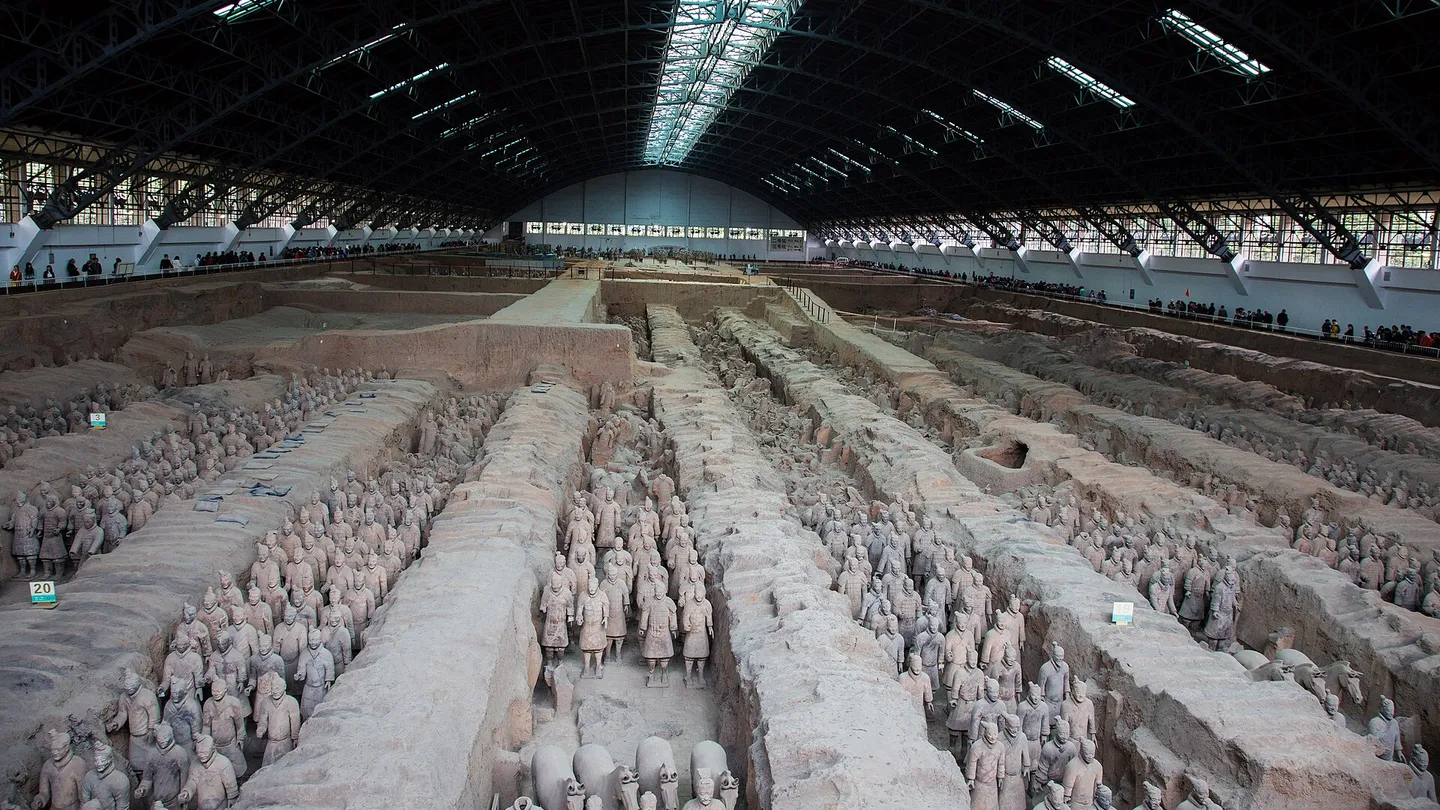
The largest pit: 230 meters long, 62 meters wide. Contains approximately 2,000 warriors on display in battle formation — infantry in the front, chariots and officers in the middle, and archers at the rear. This is the iconic view you have seen in every photo. Walk the full perimeter for different angles. The best photos are from the viewing platform at the far end, looking back toward the entrance.
Pit 2 — Cavalry & Chariots
Smaller and more complex than Pit 1. Contains cavalry units, war chariots, and kneeling archers. The lighting here is dimmer and more atmospheric. Several warriors are displayed in glass cases up close, so you can examine individual facial features and armor details from inches away.
Pit 3 — The Command Center
The smallest pit (520 sqm), believed to be the command headquarters. Contains 68 figures including high-ranking officers. Most warriors here face each other rather than outward, suggesting a strategy room rather than a battle formation. Worth 15 minutes.
Insider Tips
Arrive at 8:30 AM. The museum opens at 8:30. Pit 1 is nearly empty until 9:30. By 10:30, tour groups fill every viewing spot.
Reverse the order. Most visitors go Pit 1 → 2 → 3. Go Pit 2 → 3 → 1 instead. You will build anticipation and finish with the masterpiece.
Morning light is best. Pit 1 faces east. The morning sun streams through the hangar windows, creating dramatic light on the warriors’ faces until about 11 AM.
Combine with Huaqing Pool. Huaqing Hot Springs is 10 minutes away by taxi. Do the Warriors in the morning and Huaqing in the afternoon for an efficient day trip from downtown.
The farmer who discovered them. One of the three farmers who discovered the site in 1974 still signs books at the museum gift shop. He is usually there in the mornings.
Nearby Attractions
Tang Dynasty imperial baths. Winter hot springs are magical.
The mountain behind Huaqing. Cable car to the summit for views.
The emperor’s actual tomb, still unopened. Eerie hill with a story.
How to Get There: Step by Step
The Terracotta Warriors are in Lintong District, about 40 km east of downtown Xi'an. Here are the three most reliable routes.
Metro + Bus ($280 min) — Best Value
Take Metro Line 9 to Huaqingchi Station (40 min from city center). Exit and walk to the bus stop. Take bus 306 or 307 (labeled "Terracotta Warriors" in English) for 15 minutes. Last bus back is around 6 PM — plan accordingly.
Taxi/Didi ($18-$22 50 min) — Most Convenient
Take a taxi or Didi directly from downtown. Fixed price from most hotels is $18-$22 one-way. Show the driver: 秦始皇兵马俑博物馆. Ask them to wait ($7/hour) for the return trip, or take the metro back.
Tour Bus ($4-$7 60-90 min) — Budget Option
Tourist bus routes depart from Xi'an Railway Station Square and the East Square of the Big Wild Goose Pagoda. Look for buses clearly marked for the Terracotta Warriors. They depart when full (every 20-30 minutes).
Related Attractions
Pair these with your visit for the best itineraries.
FAQ
How much do Terracotta Warriors tickets cost?
$18 in peak season (March-November) and $15 in off-peak (December-February). Students and seniors aged 60-64 get 50% off. Children under 1.2m and seniors 65+ enter free. Tickets can be purchased at the gate or via the official WeChat mini-program. Book at least 1 day ahead during peak season.
How do I get to the Terracotta Warriors from Xi’an?
Take Metro Line 9 to Huaqing Pool Station, then bus 306 ($115 min) or taxi ($3) to the museum. Alternatively, tour bus Line 5 from Xi’an Railway Station ($160 min). A taxi from downtown costs $18-$22 and takes 40-50 minutes.
What time should I arrive at the Terracotta Warriors?
Arrive by 8:30 AM (opening time). Gates open at 8:30 AM. Pit 1 is nearly empty before 9:30 AM. Tour groups arrive around 10:00-10:30 AM. If you cannot make the morning, arrive after 3:00 PM when most groups have left.
Which pits should I visit and in what order?
Visit in this order: Pit 2 (chariots and cavalry), then Pit 3 (command center, small but fascinating), and finish with Pit 1 (the massive main hall with 2,000+ soldiers). This order builds anticipation and saves the best for last. The Exhibition Hall with the bronze chariots is between Pit 1 and Pit 2.
Can I take photos inside?
Yes, photography is allowed in all pits without flash. Tripods are not permitted inside the museum buildings. The lighting in Pit 1 is natural from the hangar windows, so morning light (8:30-10:30 AM) is best for photos.
Do I need a guide for the Terracotta Warriors?
An audio guide ($4) is good for independent travelers. A live English-speaking guide costs $22-$45 and adds enormous value — they explain details you will miss on your own, like the individual facial features, the original paint colors, and the excavation process.